
Bitcoin Near $90K as Volume Shrinks Altcoins Split
Bitcoin holds near $90,000 as trading volumes fall. See why altcoins diverge, what it means for volatility, and key levels to watch today.

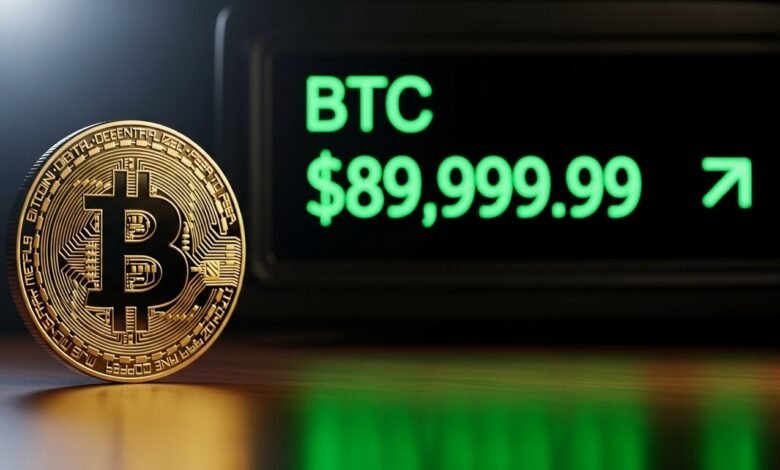
Bitcoin has a way of making the loudest statement when it does almost nothing. Today’s crypto markets are a perfect example. Bitcoin holds near $90,000, trading in a relatively tight band even as overall market participation cools. Current pricing shows Bitcoin hovering around $90,758, reinforcing the psychological power of the $90K area while signaling that traders are hesitant to make aggressive bets in either direction.
What’s especially notable is the backdrop: trading volumes are shrinking, volatility is compressing, and liquidity appears thinner than it was during the most active stretches of the recent rally. This is the kind of market environment where Bitcoin can stay steady on the surface, but the structure underneath becomes fragile—because when participation declines, moves can become sharper, faster, and more unpredictable once a catalyst arrives.
Meanwhile, the altcoin market is telling a completely different story. Rather than moving as a single “risk-on” pack, altcoins are diverging. Some sectors are outperforming, others are fading, and a growing portion of market attention is rotating into narratives like AI tokens, layer-2 ecosystems, and memecoins—even as many mid-cap assets struggle to keep up. This divergence matters, because it often signals that the market is maturing into a more selective phase where fundamentals, catalysts, and positioning matter more than broad hype.
In this “Crypto Markets Today” breakdown, we’ll explore why Bitcoin near $90,000 is so important, what shrinking trading volume means for price action, why altcoins diverge, and what traders and long-term holders should watch next. Expect a detailed, human-readable deep dive with market context, key levels, and practical insights—without the overly technical noise.
Bitcoin Holds Near $90,000: What the Market Is Really Saying
When Bitcoin holds near $90,000, it’s easy to interpret it as strength. After all, staying above such a major round number suggests buyers are defending the level. But market behavior at key psychological prices can mean two different things: consolidation before continuation, or consolidation before reversal.
Bitcoin’s current price action—around the low $90K range—reflects a market that has cooled down after recent excitement. The intraday range shows a high near $91,384 and a low around $89,641, which is a fairly contained swing for an asset as large and globally traded as Bitcoin.
This tightness can be bullish because it suggests supply is being absorbed without major sell pressure. It can also be cautious because it implies traders are waiting for confirmation from macro news, ETF flows, or broader risk markets before choosing a direction. In other words, Bitcoin is stable—but not necessarily decided.
The key takeaway is this: Bitcoin near $90,000 is a balance point. It’s where long-term conviction meets short-term uncertainty. And that’s exactly when volumes become a critical clue.
Shrinking Trading Volumes: Why It Matters More Than Price
Lower Volume Can Mean Less Conviction
The phrase “trading volumes shrink” may sound like a minor technical detail, but it often signals a major shift in market psychology. Volume is participation, and participation is what gives price movement credibility. When Bitcoin rises on strong volume, it suggests broad demand. When Bitcoin holds steady while volume fades, it indicates that fewer traders are willing to initiate new positions at current prices.
This isn’t automatically bearish. In many bull markets, volume naturally contracts during consolidations, especially after large moves. But low volume markets are vulnerable. With thinner liquidity, small bursts of buying or selling can cause oversized price swings, and stop-loss cascades can form more easily.
If you’re tracking Bitcoin holds near $90,000 while volumes remain weak, you’re watching a classic “coiled spring” setup. The market is compressing energy, and once a trigger arrives—whether macro, regulatory, or narrative-driven—the breakout can be sharp.
Why Liquidity Conditions Shape Volatility
When liquidity thins, the order book becomes less dense. That means price can jump across levels more quickly. In these conditions, Bitcoin often moves in sudden bursts rather than smooth trends. It also increases the likelihood of “fakeouts,” where price breaks a support or resistance level briefly, triggers liquidations, then reverses.
This is one reason traders obsess over volume when Bitcoin holds near $90,000. A sustained breakout above resistance with rising volume is a stronger signal than a breakout on weak volume. Likewise, a dip below support with heavy volume can suggest genuine distribution.
In today’s environment, shrinking volume suggests one thing above all: the market is waiting. And while Bitcoin waits, altcoins are fighting for attention.
Altcoins Diverge: Why the Market Is Splitting Into Winners and Losers
The most interesting part of today’s crypto market isn’t Bitcoin’s stability—it’s how altcoins diverge. In earlier stages of bull cycles, altcoins often move together because liquidity floods the market broadly. But as a cycle matures, capital becomes more selective. Traders rotate into themes, seek catalysts, and chase momentum.
This is exactly what we’re seeing now. Instead of a uniform “altcoin season,” the market is experiencing fragmented rallies. Some ecosystems are catching strong bids, while others are quietly bleeding.
This divergence can happen for several reasons:
First, narrative rotation. Markets love stories, and crypto is one of the most narrative-driven asset classes in the world. Tokens tied to hot themes like AI, restaking, and scaling solutions tend to draw fresh attention faster than projects that lack immediate catalysts.

Second, token supply dynamics. Unlock schedules, emissions, and staking rewards can heavily influence performance. Even strong projects can underperform if token inflation is high or unlocks are imminent.
Third, market structure. When Bitcoin holds near $90,000 and volume shrinks, traders look for action elsewhere. That pushes speculative flows into select altcoins—often those with the highest volatility, strongest communities, or most aggressive momentum.
The result is a market where “altcoins” aren’t one trade anymore. They’re a collection of micro-markets—and that’s why divergence matters.
Bitcoin Dominance and Risk Appetite: The Hidden Driver
What Bitcoin Dominance Tells You About Altcoins
To understand why altcoins diverge, you need to pay attention to Bitcoin dominance—the percentage of the total crypto market cap represented by Bitcoin. When dominance rises, it often means capital is consolidating into Bitcoin and away from riskier assets. When dominance falls, it suggests risk appetite is expanding into altcoins.
In a period where Bitcoin holds near $90,000, dominance can either stay firm (indicating traders trust Bitcoin most) or slip (indicating rotation into selected altcoins). The divergence we’re seeing suggests dominance may not be collapsing broadly—because we don’t have a unified altcoin rally—but capital is selectively rotating into pockets of the market.
This creates a tricky environment: some traders will feel like the bull market is raging because their chosen altcoin is exploding, while others feel like the market is dead because their portfolio is stagnant. That emotional disconnect is a hallmark of divergence phases.
“Risk-On” vs. “Selective Risk-On”
The biggest misconception right now is that the market is either risk-on or risk-off. In reality, it’s often both. Bitcoin can be stable and conservative while certain altcoin segments behave like pure speculation.
This is why today’s crypto markets feel strange: Bitcoin near $90,000 looks calm, but selected altcoins are hyperactive. That doesn’t mean the market is irrational—it means liquidity is being distributed unevenly.
In selective risk-on environments, winners can run far, but losers can drift for weeks. That’s why traders increasingly focus on catalysts, narratives, and on-chain signals instead of assuming “everything will pump.”
Key Technical Levels: What Traders Are Watching on Bitcoin
Even if you’re not a technical trader, it’s useful to understand why certain levels matter—especially when Bitcoin holds near $90,000.
The $90,000 zone is a psychological pivot. Traders anchor expectations around it, and institutions often treat round numbers as meaningful reference points. Holding above $90K signals strength; losing it can create quick fear and liquidation pressure.
Above the market, the area near the intraday high around $91,384 becomes a near-term resistance reference. A clean break above that with stronger volume could trigger a momentum wave. Below, the intraday low around $89,641 is a near-term support marker. If Bitcoin dips below that and fails to reclaim quickly, it could invite deeper pullbacks.
What’s crucial is the relationship between volume and level breaks. If Bitcoin breaks above resistance while trading volumes shrink, that breakout may be less reliable. If volume expands during a move, it suggests commitment. In a low-volume environment, traders often wait for confirmation rather than reacting to the first move.
Why Bitcoin’s Stability Can Be Bullish for Altcoins
A stable Bitcoin often creates the best environment for altcoins—when conditions are right. When Bitcoin is highly volatile, it sucks liquidity out of altcoins because traders prefer safety and because exchanges tighten risk conditions. When Bitcoin holds near $90,000 and volatility compresses, it can free up attention and capital for altcoin speculation.
However, this only turns into a broad altcoin rally if liquidity is expanding across the market. Right now, because trading volumes are shrinking, we’re seeing a more selective version of that phenomenon. Instead of a market-wide altcoin boom, we’re seeing smaller rotations.
This is where the divergence becomes a signal: it suggests the market isn’t in full mania mode. It’s in a phase where money is moving carefully, hunting for high-conviction setups.
For long-term investors, this can be positive because it often leads to healthier market structure. For short-term traders, it can be dangerous because the wrong altcoin bet can underperform badly even while the overall market looks stable.
Macro and Narrative Catalysts: What Could Move Bitcoin Next?
Even though Bitcoin’s chart matters, the biggest price movements often come from catalysts.
When Bitcoin holds near $90,000, traders are watching for triggers such as:
Institutional flows and ETF demand. Sustained inflows can keep Bitcoin supported even if retail volume fades, because institutional demand tends to be steadier.
Interest rate expectations and macro risk sentiment. Bitcoin trades increasingly like a macro-sensitive asset, especially during periods of market stress or enthusiasm.
Regulatory headlines. Crypto reacts quickly to policy developments because regulatory clarity can unlock new capital—or create sudden fear.
Network and ecosystem developments. Major upgrades or adoption milestones can improve sentiment, though Bitcoin tends to respond more to liquidity and macro forces than to technical upgrades alone.
The market’s quiet volume suggests traders expect news. The moment a credible catalyst appears, today’s low-volatility environment could flip quickly.
What This Means for Traders and Long-Term Investors
For Traders: Patience Is a Strategy
In a market where Bitcoin holds near $90,000 and trading volumes shrink, the worst habit is overtrading. Low-volume markets often punish aggressive entries because price can drift, fake out, and whipsaw.
Traders tend to do better by waiting for:
- A level break with confirmation (volume expansion, strong close, follow-through).
- Clear divergences in momentum indicators.
- Stronger liquidity windows (such as U.S. market hours).
Altcoin divergence also means trade selection is everything. “Buy any altcoin” is not a strategy in this environment.
For Investors: Consolidation Isn’t Failure
For long-term holders, today’s setup can be reassuring. Bitcoin near $90,000 suggests the market is absorbing supply at high prices. Consolidation phases build structure, reduce leverage, and prepare the market for the next trend move.
Altcoin divergence is also useful information. It suggests the market is rewarding clear narratives and strong positioning. Investors can use this phase to evaluate which projects demonstrate real user growth, developer activity, and sustainable token dynamics.
Conclusion
Crypto markets today are defined by contrast. Bitcoin holds near $90,000, showing resilience and stability even as trading volumes shrink and participation cools. At the same time, altcoins diverge, creating a market where select narratives and catalysts outperform while others stagnate.
This combination often signals a transitional phase. Bitcoin’s consolidation can act as a launchpad, but shrinking volume warns that the next major move may require a catalyst and could be more violent once it arrives. Meanwhile, altcoin divergence suggests capital is no longer blindly rotating—it’s choosing winners more carefully.
Whether you’re trading short-term volatility or building long-term exposure, the takeaway is simple: watch volume, respect key levels, and don’t assume the entire market will move together. In a selective environment, patience and precision matter more than hype.
FAQs
Q: Why does Bitcoin holding near $90,000 matter so much?
Because $90,000 is a major psychological level that influences trader behavior. Holding above it can signal strength, while losing it can trigger fear, liquidations, and faster downside moves.
Q: Is shrinking trading volume bearish for Bitcoin?
Not always. It can simply mean the market is consolidating. But low volume reduces conviction and can make the market more vulnerable to sudden spikes in volatility when news or large orders hit.
Q: Why are altcoins diverging instead of rallying together?
Because capital is rotating selectively into specific narratives and catalysts. In this phase, tokenomics, liquidity, and market attention matter more, so some altcoins outperform while others lag.
Q: Can a stable Bitcoin help altcoins perform better?
Yes. When Bitcoin is stable, traders often feel safer taking risk in altcoins. However, if overall trading volumes shrink, the altcoin rally may be narrow and selective instead of broad-based.
Q: What should I watch next in crypto markets today?
Watch whether Bitcoin can hold above $90K with improving volume, monitor key support near the high $89K area, and track whether altcoin strength spreads beyond a few hot sectors into the wider market.
Also More: Bitcoin Ether Ease as Markets Price Fed Cuts