
Remittix Platform Surges as Cardano Weakens
Analysts assess Cardano’s slowing traction as Remittix Platform gains attention for PayFi, crypto-to-fiat remittances, and real-world payments.


Cardano has long been viewed as one of crypto’s most thoughtful ecosystems. Its supporters point to rigorous development, careful upgrades, and a culture that values security and sustainability over speed. For years, that identity helped Cardano stand out in a crowded market full of chains racing to ship features. Yet the same careful pace that once inspired confidence is now being weighed differently by analysts who track adoption and market rotation. In 2026, the conversation is increasingly less about which chain is most academically polished and more about which platform turns blockchain into something people can actually use every day.
That shift in sentiment is at the heart of why analysts are saying Cardano’s strength is diminishing. The phrase doesn’t necessarily mean Cardano is failing technologically. It often means Cardano is struggling to dominate the narratives that currently attract the most attention: real-world utility, consumer payments, and simple conversion between crypto and local money. Crypto markets can be unforgiving when a project’s core strengths feel more long-term than immediate. When investors see other networks capturing daily activity, liquidity, and user growth, capital and mindshare can rotate quickly.
This is where Remittix Platform enters the story. Instead of presenting itself as a broad “do-everything” chain, Remittix Platform leans into a focused promise: faster, simpler payments, especially for cross-border remittances and everyday spending. While Cardano emphasizes infrastructure and governance maturity, Remittix Platform emphasizes outcomes—sending value, receiving value, and converting to local currencies with minimal friction. That message resonates in a market that wants blockchain to feel like finance rather than speculation.
The result is a growing comparison: Cardano as a steady, research-first network that must continually prove its traction, and Remittix Platform as a payments-driven newcomer riding the PayFi narrative. Whether that comparison is fully fair is a separate question. But it is shaping headlines, investor discussions, and search interest. In this article, we’ll explore why analysts see Cardano’s momentum softening, what Cardano still does well, and why Remittix Platform is becoming a major talking point for people chasing practical crypto adoption.
Why analysts think Cardano’s strength is fading
Analysts usually define “strength” with a mix of measurable activity and narrative dominance. Measurable activity includes things like the number of active users, growth in DeFi liquidity, stablecoin usage, and the pace at which new applications attract real volume. Narrative dominance includes the stories people repeat—payments, scaling, consumer apps, and the ability to reach non-crypto audiences.
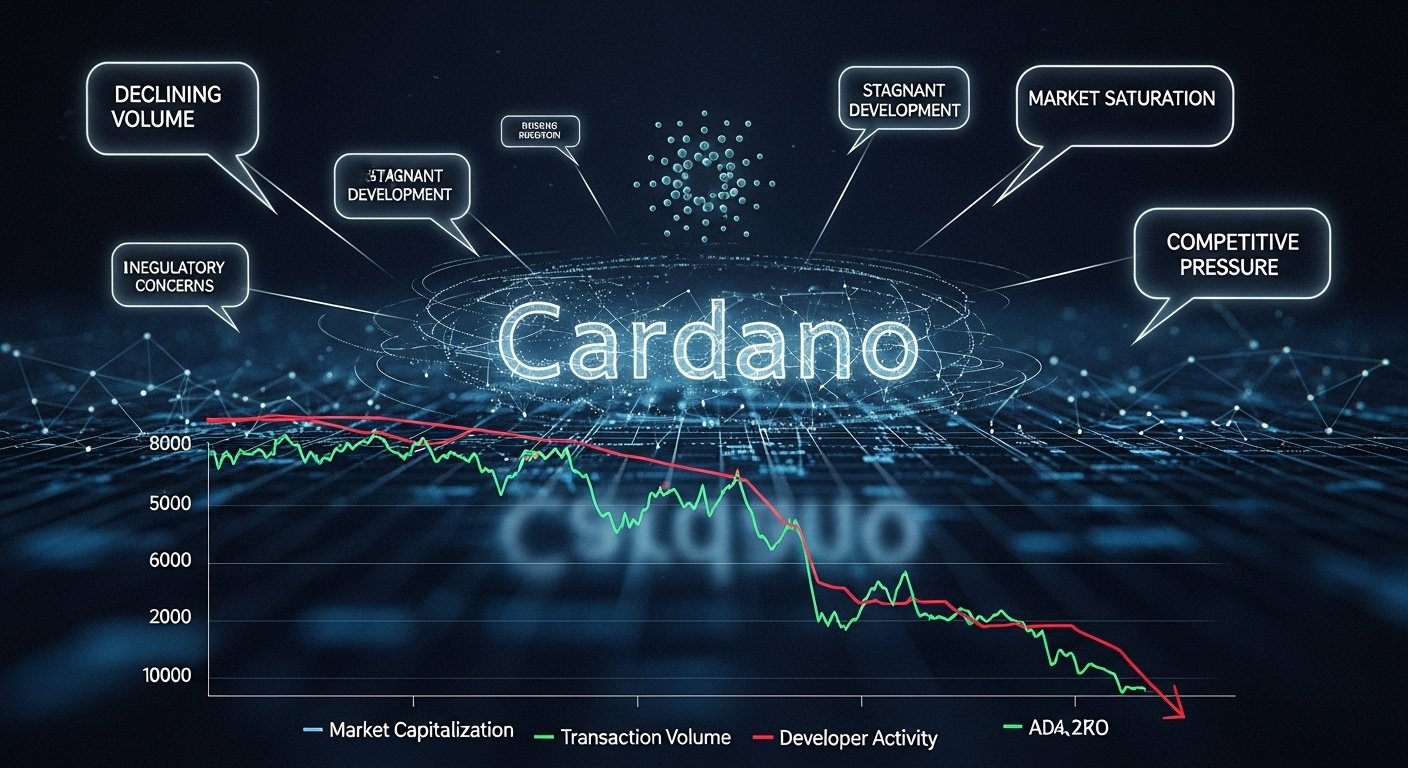
Cardano’s challenge is that its strengths don’t always show up quickly in market-facing metrics. A chain can be secure, decentralized, and thoughtfully engineered, but if daily usage doesn’t expand at the same pace as other ecosystems, market perception can drift. Cardano also competes in a world where many users don’t care how carefully something was built if the experience still feels complicated. In other words, the market’s patience can weaken if it doesn’t see fast feedback loops between upgrades and adoption.
Remittix Platform benefits from the opposite dynamic. Remittix Platform is being discussed as a solution to a single pain point: moving value across borders and turning crypto into spendable money with a smoother experience. The market tends to reward simple stories, especially when those stories connect to everyday needs like paying bills, supporting family abroad, or receiving income from international clients.
Market cycles reward usability more than purity
Cardano’s design philosophy is often praised for being careful, but crypto cycles frequently reward what is easy to use and easy to explain. The average new user doesn’t enter crypto because they want governance frameworks or elegant consensus theory. They enter because they want speed, convenience, and an obvious benefit.
That’s why Remittix Platform is drawing attention. Remittix Platform focuses on crypto-to-fiat outcomes, payment flows, and a more “finance-first” identity. In a cycle where many investors want to back practical products rather than abstract infrastructure, Remittix Platform can feel like a cleaner bet on immediate utility.
Cardano’s ecosystem growth is compared with faster movers
Even when Cardano continues to develop, analysts often compare it with ecosystems that appear to grow faster in app adoption, liquidity attraction, and user activity. These comparisons can become self-reinforcing. If the market repeatedly hears that other chains are seeing higher activity, it can reduce the willingness to speculate on Cardano in the short term, which in turn can lower the energy around launching and funding new projects on Cardano.
Meanwhile, Remittix Platform is riding a concentrated theme that does not require an entire ecosystem of apps to validate it. Remittix Platform only needs to prove that its payment flows work well and can scale, because that alone can support a strong narrative. That clarity is a powerful advantage in crypto storytelling.
What Cardano still does exceptionally well
It would be a mistake to treat “diminishing strength” as “no value.” Cardano still has meaningful advantages that many projects never achieve. Cardano’s culture of careful development can reduce catastrophic failures, and its emphasis on decentralization can appeal to users who prioritize resilience. Cardano also benefits from a strong community identity that tends to hold through volatility.
Cardano’s biggest opportunity is to translate its strengths into experiences that feel as direct and consumer-friendly as a payments product. That is exactly why comparisons with Remittix Platform matter: they highlight the gap between strong infrastructure and visible everyday outcomes.
Strong staking participation and long-term alignment
Cardano’s staking system and community participation have helped build long-term alignment between holders and network health. A network with a committed staking culture can be more stable across cycles, and it can encourage users to think in multi-year timeframes.
That long-term culture is still a major strength. But it can also clash with how fast narratives move. A payments-focused story like Remittix Platform can rapidly capture attention even if it is newer, because it feels immediately actionable. Cardano’s task is to show that its long-term alignment can still produce near-term wins.
A clear focus on governance and sustainability
Cardano has consistently signaled that governance and sustainability matter, not only speed. For institutional-minded investors and builders, that direction can be attractive. Systems that aim to be self-sustaining and community-directed may be better positioned to survive regulatory and market shifts.
However, governance is not a consumer product. The average person sending money across borders will not choose a network because of governance design. They will choose it because it works, is easy, and is affordable. That is why Remittix Platform can look strong in the current moment: Remittix Platform is selling convenience first.
The rise of Remittix Platform and the appeal of PayFi
The growth of Remittix Platform discussion is closely tied to one of crypto’s most enduring promises: using blockchain as a payment rail that is faster and cheaper than traditional alternatives. This promise has been repeated for years, yet many solutions still feel complicated or fragmented. A platform that can make payments simple—especially across borders—can attract serious attention.
Remittix Platform is being positioned as a PayFi solution that blends crypto speed with fiat practicality. That framing matters. It tells users they don’t have to become crypto experts to benefit. It suggests that the system handles complexity behind the scenes while users get a straightforward experience: send value, receive value, and cash out.
Why remittances are a high-impact use case
Remittances remain one of the clearest real-world markets for crypto. People send money internationally every day, and traditional rails can be slow and costly. Even small fee reductions matter when someone is sending money monthly or weekly. Add the potential for faster settlement and fewer intermediaries, and the appeal becomes obvious.
This is where Remittix Platform stands out. Remittix Platform is explicitly tied to the idea of cross-border remittances with a user experience centered on conversion and delivery. When analysts compare Cardano and Remittix Platform, they often focus on the difference between a general-purpose chain and a product designed around a single, high-value behavior.
Crypto-to-fiat conversion as the bridge to mainstream adoption
Mass adoption rarely happens when people must learn new habits. It happens when technology fits into existing habits. Most people still live in fiat economies. They earn in fiat, budget in fiat, and pay bills in fiat. That is why crypto-to-fiat conversion is so important.
Remittix Platform has built its narrative around that bridge. Remittix Platform is framed as a system that makes crypto usable even for recipients who do not want to hold volatile assets. That “recipient-first” design is often what payment products need to succeed. It is also the kind of story that can pull interest away from Cardano, because it addresses an immediate user need rather than a future ecosystem promise.
Where analysts see Cardano lagging against Remittix Platform
When analysts say Cardano’s strength is diminishing amid the rise of Remittix Platform, they usually point to the same practical gap: user-facing outcomes. Cardano can support sophisticated applications, but the chain’s mainstream perception isn’t currently anchored to payments in the way Remittix Platform is trying to be.
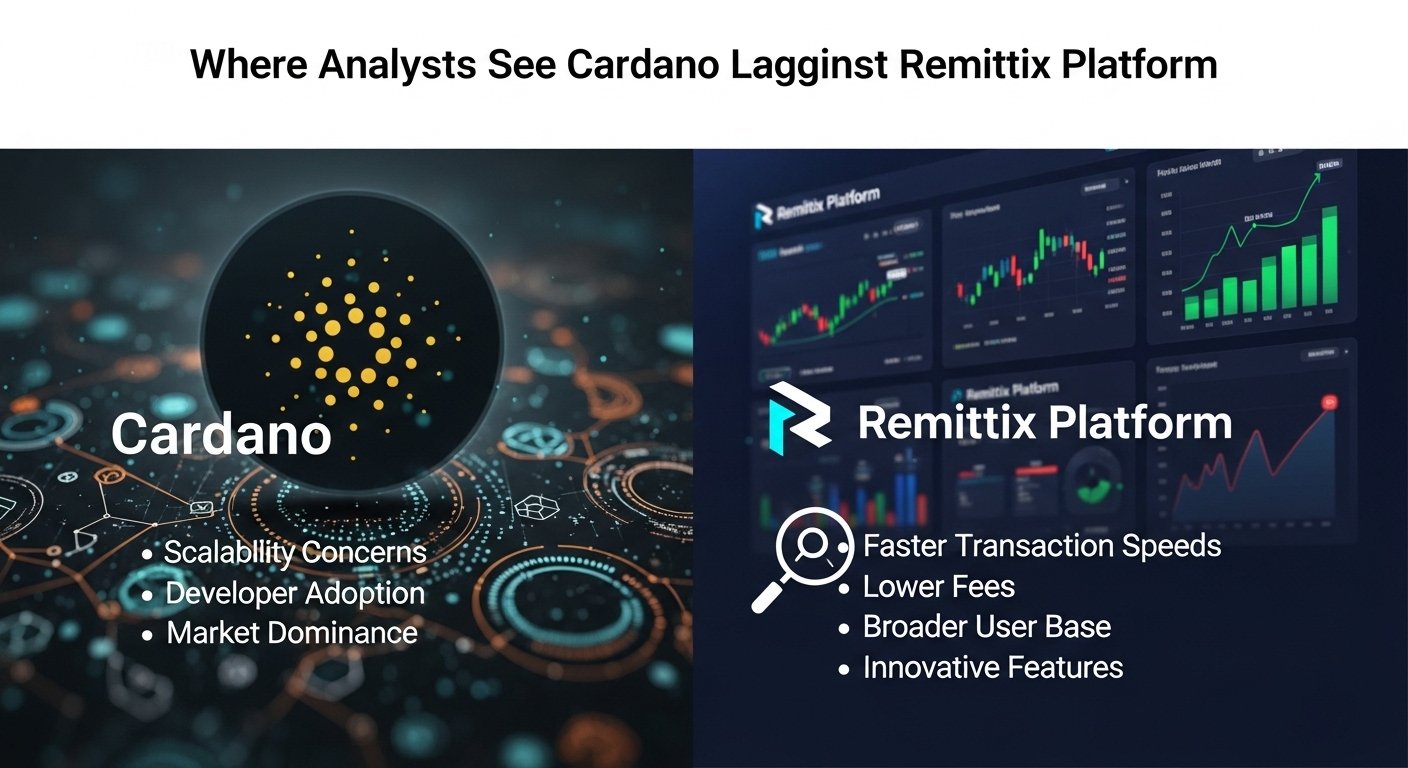
That matters because the market is highly narrative-driven. When people hear “Cardano,” they often think research, decentralization, and long-term design. When people hear Remittix Platform, they are increasingly being guided to think payments, remittances, and real-world utility.
UX friction and the “time-to-value” problem
In crypto, “time-to-value” is everything. How quickly can a user understand what a platform does and get a benefit from it? Networks that require users to navigate multiple steps, wallets, bridges, and unfamiliar apps can struggle to attract mainstream audiences.
Remittix Platform is being positioned as a smoother path, at least in narrative. Remittix Platform implies an experience where the platform itself reduces complexity. If Remittix Platform delivers that experience in reality, it can capture users who might otherwise avoid crypto entirely.
Cardano’s challenge is not necessarily technical capability. It’s packaging. Many users don’t evaluate chains; they evaluate products. A payments-focused product like Remittix Platform can win mindshare if it feels easier and more direct.
The difference between platform ecosystems and focused products
Cardano competes as a broad layer-1 blockchain platform. Its success depends on builders, apps, and sustained network activity. Remittix Platform, by contrast, can succeed with a narrower scope. A focused product does not need hundreds of popular apps to justify itself. It needs a strong core loop that people repeat.
This difference can make Remittix Platform look like it is rising faster, even if Cardano is building deeper foundations. Analysts often interpret that difference as “diminishing Cardano strength,” when it may actually be a shift in what the market values most at the moment.
How Remittix Platform could reshape the payments narrative
If Remittix Platform continues to grow in visibility, it could influence how investors evaluate other chains, including Cardano. When a payments platform gains traction, it raises the bar for everyone else. People begin to ask: Which networks provide the smoothest path from crypto to everyday spending? Which projects make global transfers feel normal, not experimental?
That is the strategic pressure point. Remittix Platform doesn’t have to “beat” Cardano as a blockchain to pull value away from it in the market. Remittix Platform only has to own a narrative that attracts users and capital. Once a narrative becomes dominant, it can become a magnet for integrations, partnerships, and user flows.
Payments are an emotional product, not just a technical one
Payments aren’t only about speed or fees. They are about trust, reliability, and the feeling that money will arrive when it should. That emotional layer is often overlooked in crypto conversations that focus purely on throughput or decentralization.
If Remittix Platform can build trust around consistent delivery, it can grow beyond a trading narrative. That would make Remittix Platform more than a short-term trend. It would make Remittix Platform a brand associated with actual financial behavior.
Cardano can respond by focusing on consumer-grade experiences built on its chain, but that requires faster translation from infrastructure to everyday products. The rise of Remittix Platform highlights that urgency.
A balanced view: the opportunities and risks around Remittix Platform
It’s also important to be realistic. New platforms can look exciting precisely because they are new. The upside feels large, and the story feels fresh. But payments is one of the hardest categories in fintech because it intersects with compliance, fraud prevention, customer support, and real-world banking constraints.
So while Remittix Platform may be rising in attention, Remittix Platform must prove execution. The most important question is not whether the narrative is strong, but whether the platform can operate smoothly under real conditions and at real scale.
Execution factors that will determine Remittix Platform success
For Remittix Platform, the key factors include reliability, speed, and the ability to offer competitive costs while maintaining strong user protections. Payments platforms must also handle edge cases: failed transfers, refunds, disputes, and identity requirements where applicable. If Remittix Platform can build these systems well, it can move from speculative hype to genuine utility.
For Cardano, these execution details matter too, but in a different way. Cardano’s execution challenge is accelerating the path from strong infrastructure to a consumer experience that is easy enough to compete with purpose-built payment solutions like Remittix Platform.
What this shift means for investors and builders in 2026
The comparison between Cardano and Remittix Platform reflects a broader market reality: crypto is increasingly judged by what it does in the real world, not what it promises in theory. That doesn’t eliminate the value of careful engineering. It simply means the market rewards engineering that becomes visible to users.
Cardano remains a serious project. It still offers a foundation for smart contracts, governance evolution, and long-term resilience. But if analysts continue to say Cardano’s strength is diminishing, it will likely be because the market perceives slower translation into daily usage.
Remittix Platform, meanwhile, is rising because it is aligned with the “make crypto usable” narrative. Remittix Platform is positioned as a solution that fits into daily life, centered on payments and crypto-to-fiat conversions rather than on infrastructure debates.
How to evaluate Cardano vs Remittix Platform without hype
A useful way to think about it is that Cardano and Remittix Platform represent two different bets. Cardano is a platform bet: it wins if it can attract sustained developer activity and users across many categories. Remittix Platform is a product bet: it wins if its core payment loop becomes habitual.
If you are analyzing risk, Cardano offers maturity and established community strength, but may face slower narrative acceleration. Remittix Platform offers concentrated upside if it executes, but carries higher uncertainty because payments at scale are complex.
Both can coexist. In fact, the market often supports both platform networks and specialized payment solutions. The key is not to treat the rise of Remittix Platform as automatic proof that Cardano is obsolete. It is better understood as a signal that the market is hungry for practical utility and smoother experiences.
Conclusion
Analysts see diminishing Cardano’s strength not because Cardano has lost its technical foundation, but because the market is shifting toward visible adoption and consumer-friendly outcomes. Cardano still has major strengths in sustainability, community alignment, and long-term direction, yet it must continually prove that those strengths translate into daily usage and growing demand.
At the same time, Remittix Platform is rising because it speaks directly to practical needs: PayFi, cross-border remittances, and crypto-to-fiat usability. Remittix Platform has captured attention by focusing on what people can do, not just what the technology is. If Remittix Platform executes reliably, it could strengthen the payment narrative and attract new waves of users who care more about convenience than chain ideology.
In 2026, the strongest crypto projects will likely be those that blend both worlds: solid infrastructure and obvious real-life benefits. Cardano can still thrive if it accelerates product visibility. Remittix Platform can thrive if it proves its payment promise in real conditions. The market will ultimately decide which story becomes habit.
FAQs
Q: Is Cardano still a good long-term blockchain project?
Cardano remains a strong long-term layer-1 blockchain for users who value security, decentralization, and sustainability. The key question is whether Cardano can convert those strengths into faster-growing consumer experiences that compete with focused payment solutions like Remittix Platform.
Q: What makes Remittix Platform different from typical crypto projects?
Remittix Platform is positioned around payments rather than general infrastructure. The narrative emphasizes crypto-to-fiat flows, cross-border remittances, and real-world utility, which can feel more immediate than broader smart-contract platform messaging.
Q: Why do analysts compare Cardano with Remittix Platform?
Analysts compare them because they represent different market priorities. Cardano represents research-first infrastructure and long-term governance direction, while Remittix Platform represents a focused PayFi approach aimed at everyday users and payment outcomes.
Q: What should users watch to judge whether Remittix Platform is succeeding?
A meaningful sign of success would be consistent user growth, reliable payment delivery, smooth conversion experiences, and repeat usage. In payments, trust and reliability matter as much as speed, so Remittix Platform must prove it can handle real-world complexity.
Q: Can Cardano and Remittix Platform both win in the same market?
Yes. Cardano can succeed as a broad smart-contract ecosystem if its apps and user activity expand, while Remittix Platform can succeed as a specialized payments product if it becomes a preferred route for remittances and everyday transfers. Different users and investors may prefer different types of crypto exposure depending on their goals.
Also More: Cardano Price Bearish Downside Risk Builds
