
DeFi Is Finally Moving From Apps to Systems With Fewer Interfaces
DeFi is evolving from fragmented apps into seamless systems with fewer interfaces, better UX, and scalable on-chain infrastructure.

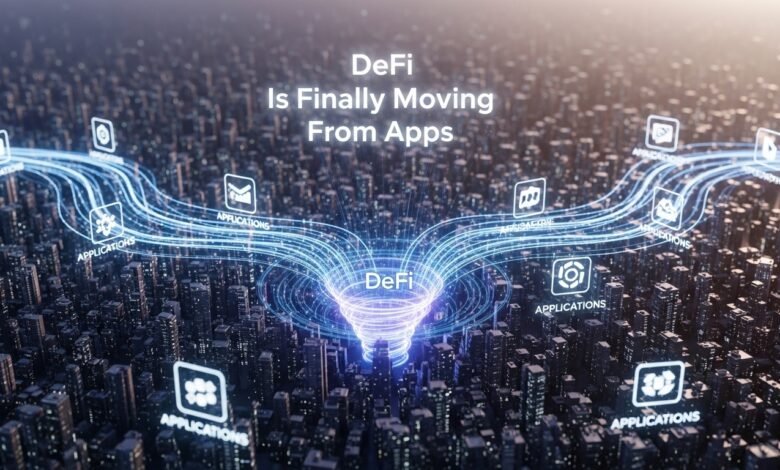
Decentralized Finance (DeFi) has promised a financial system without intermediaries, borders, or permission. And in many ways, it delivered. Billions of dollars moved on-chain, smart contracts replaced banks, and users gained unprecedented control over their assets. Yet despite this progress, one major obstacle has consistently held DeFi back from mainstream adoption: interfaces.
Early DeFi grew through isolated apps—wallets, DEXs, lending protocols, bridges, yield optimizers—each with its own UI, logic, and learning curve. Power users learned to juggle them, but for most people, the experience felt fragmented, confusing, and risky. Clicking through five interfaces just to execute one financial strategy was never sustainable.
Now, something fundamental is changing. DeFi is finally moving from apps to systems with fewer interfaces, and this shift represents one of the most important evolutionary steps in the entire ecosystem. Instead of forcing users to manually coordinate actions across multiple platforms, modern DeFi systems are abstracting complexity, compositing protocols behind the scenes, and delivering outcomes rather than workflows. This article explores how and why this transformation is happening, what technologies are enabling it, and what it means for users, developers, and the future of decentralized finance.
Powerful Apps, Fragmented Experiences
In its first major growth phase, DeFi evolved as a collection of specialized applications. Each protocol focused on doing one thing extremely well—swapping tokens, lending assets, minting stablecoins, or farming yield. From a technical perspective, this modularity was a strength. From a user perspective, it created friction.
Users had to understand multiple interfaces, manage approvals, bridge assets between chains, and manually sequence transactions. Even experienced participants faced constant cognitive load, while newcomers were often overwhelmed before completing their first transaction.
This app-centric model also introduced risks. Switching between platforms increased exposure to smart contract vulnerabilities, phishing attacks, and user error. A single misclick could result in irreversible loss. As DeFi grew more complex, the gap between what was possible and what was usable widened.
Why Interfaces Became DeFi’s Bottleneck
The interface problem wasn’t just about aesthetics or UX polish. It was structural. DeFi apps exposed raw protocol mechanics directly to users, requiring them to think like developers rather than financial participants. As strategies became more sophisticated—combining lending, liquidity provision, derivatives, and automation—the number of steps multiplied. This complexity limited adoption and reinforced the perception that DeFi was only for technically savvy users.

At the same time, regulators and institutions struggled to engage with DeFi because fragmented interfaces made risk assessment, compliance, and monitoring more difficult. The ecosystem needed a new abstraction layer—one that reduced surface complexity without sacrificing decentralization.
Shift From Apps to Systems: A Structural Evolution
The current transition marks a move away from isolated apps toward integrated DeFi systems. These systems orchestrate multiple protocols behind a single logical interface or, in some cases, no visible interface at all.
Instead of asking users to manage individual actions, these systems focus on outcomes. A user no longer needs to manually lend, borrow, swap, and stake. They simply specify an intent, and the system executes the required steps automatically. This is why DeFi is finally moving from apps to systems with fewer interfaces. The value is shifting from front-end differentiation to backend orchestration, automation, and composability.
Intent-Based Architecture and Invisible UX
One of the most important enablers of this shift is intent-based architecture. Rather than interacting with contracts directly, users express what they want to achieve. The system determines how to fulfill that intent efficiently and securely. This approach dramatically reduces the need for multiple interfaces. In some cases, the interface disappears entirely, replaced by APIs, agents, or embedded logic within wallets and applications.
Intent-based DeFi also improves efficiency by bundling transactions, optimizing gas usage, and reducing failed executions. It turns DeFi from a manual process into a service-oriented system that feels closer to traditional finance—without sacrificing decentralization.
Account Abstraction and Smart Wallets
Another major driver of fewer interfaces is account abstraction. Traditional externally owned accounts (EOAs) forced users to sign every action manually. Smart accounts change that paradigm. With smart wallets, complex transaction flows can be executed automatically, permissions can be delegated safely, and recovery mechanisms can be built in. This allows DeFi systems to operate in the background while users interact through simplified touchpoints. Account abstraction also enables features like session keys, batched transactions, and gas abstraction, further reducing friction. As a result, the need to constantly jump between apps is disappearing.
Composability Without Complexity
Composability has always been DeFi’s superpower. Protocols can stack, integrate, and interact permissionlessly. The problem was that users had to manage that composability themselves. Modern DeFi systems preserve composability at the protocol level while hiding it at the user level. Users benefit from sophisticated strategies without needing to understand how each component works.
How Fewer Interfaces Improve Security and Trust
Reducing interfaces doesn’t just improve UX; it also enhances security. Every additional interface increases the attack surface. By consolidating interactions into fewer, more trusted systems, users are exposed to fewer phishing attempts and malicious contracts.
Automated systems can also enforce best practices, such as slippage limits, risk thresholds, and transaction simulation. This reduces human error, which remains one of the biggest causes of loss in DeFi. In this sense, DeFi systems with fewer interfaces are not less transparent—they are more protective, guiding users through safe execution paths.
Role of Infrastructure Protocols

As DeFi evolves, infrastructure protocols are becoming more important than consumer-facing apps. These include execution layers, solver networks, automation frameworks, and middleware that coordinate activity across chains and protocols. These systems often operate invisibly, powering wallets, exchanges, and applications without branding themselves as standalone products. Their success is measured not by user clicks, but by reliability, efficiency, and integration depth. This infrastructure-first mindset is another reason DeFi is finally moving from apps to systems with fewer interfaces. The front end is becoming lighter, while the backend grows more intelligent.
Institutional Adoption and Enterprise Readiness
Institutions have long been interested in DeFi’s efficiency but wary of its complexity. Fragmented interfaces made integration costly and risky. System-based DeFi changes that. Enterprises can integrate with a single execution layer or API instead of dozens of apps. Compliance tools, reporting, and risk management can be embedded at the system level. As a result, DeFi is becoming more compatible with enterprise blockchain adoption, opening the door to new capital flows and use cases.
Cross-Chain Systems and Unified Liquidity
Cross-chain fragmentation once multiplied interface problems. Each bridge, network, and liquidity pool required separate interaction. Modern DeFi systems increasingly treat chains as infrastructure rather than destinations. Liquidity is abstracted, routing is automated, and users don’t need to care where execution happens. This unified approach aligns perfectly with the trend toward fewer interfaces. Users interact with a system, not a chain.
The Impact on Developers and Builders
For developers, this shift changes priorities. Instead of competing on UI alone, builders now focus on reliability, composability, and execution quality. Open standards, shared infrastructure, and protocol-level innovation matter more than branding. Teams that build robust systems can power dozens of front ends without being visible to end users. This mirrors how the internet evolved—most users don’t know which protocols run beneath their apps, and they don’t need to.
Challenges and Trade-Offs
While the move toward systems is powerful, it introduces new challenges. Abstraction can reduce transparency if not designed carefully. Users must trust systems to act in their best interest. Governance, open-source standards, and auditability become even more important. The goal is not to hide DeFi, but to make it usable without obscuring its principles. Striking the right balance will define the next phase of DeFi’s evolution.
Finance as an Autonomous System
As automation, intent-based execution, and smart accounts mature, DeFi begins to resemble an autonomous financial system rather than a collection of apps. Users set preferences, define goals, and let systems handle execution. Interfaces become optional touchpoints rather than mandatory control panels. This is the logical conclusion of decentralization—not complexity for its own sake, but freedom through simplicity.
Conclusion
The move from apps to systems represents DeFi growing up. It acknowledges that true adoption requires more than powerful protocols—it requires usability, safety, and coherence. DeFi is finally moving from apps to systems with fewer interfaces, and this transition is not a trend. It is an architectural necessity. By reducing friction, improving security, and enabling scale, system-based DeFi brings decentralized finance closer to fulfilling its original promise. The next generation of users may never know how many protocols power their transactions—and that’s exactly the point.
FAQs
Q: What does it mean that DeFi is moving from apps to systems?
It means DeFi is shifting from isolated applications to integrated systems that handle complex processes behind the scenes, requiring fewer user interfaces.
Q: Why are fewer interfaces better for DeFi users?
Fewer interfaces reduce complexity, lower the risk of errors, improve security, and make DeFi more accessible to non-technical users.
Q: Does this reduce decentralization?
No. The decentralization remains at the protocol level. The abstraction simply improves usability while preserving permissionless infrastructure.
Q: How do intent-based systems work in DeFi?
Users specify desired outcomes instead of steps. The system automatically determines and executes the required transactions across protocols.
Q: Will traditional financial institutions use these systems?
Yes. System-based DeFi is far more compatible with institutional requirements, making adoption more practical and scalable.
Also Read: DeFi Technologies Faces Legal Hurdles in Europe Expansion