
Bitcoin Ether Ease as Markets Price Fed Cuts
Bitcoin and ether cool after an early January pop as traders price Fed cuts. Explore what’s driving crypto, rates, ETF flows, and what’s next.


Bitcoin and ether began the new year with a burst of optimism, surging higher as traders embraced a familiar macro narrative: the U.S. Federal Reserve is expected to cut interest rates later in the year, liquidity conditions could improve, and risk assets may benefit. That early January pop helped Bitcoin reclaim strong ground and pushed ether higher alongside it, reigniting bullish sentiment across the crypto market. But as quickly as momentum arrived, the market cooled. Bitcoin and ether eased back, reflecting profit-taking, shifting expectations, and the reality that crypto markets rarely move in a straight line.
This pattern—rally first, pause later—is not a sign that the market has “broken.” It’s a reflection of how markets behave when they’re trying to price multiple forces at once. Crypto is especially sensitive to the tension between optimism and caution. When traders believe rate cuts are coming, they tend to rotate into higher-beta assets such as Bitcoin and ether. But when macro uncertainty returns—whether that’s a stronger jobs report, sticky inflation, or cautious messaging from policymakers—traders reduce exposure, lock in gains, and wait for confirmation.
The phrase “Bitcoin, ether ease after early January pop as markets price fed cuts” captures this exact moment: a market that is still constructive long-term but cautious short-term, because everything depends on how quickly and how deeply the Fed will cut. It’s also a reminder that crypto has increasingly become a macro-linked asset class. Bitcoin and ether now respond not only to crypto-native catalysts, but also to broader financial conditions, bond yields, the U.S. dollar, and institutional flows.
In this article, we’ll explore why Bitcoin and ether eased after their early January pop, how markets price Fed cuts, and why that matters for crypto investors. We’ll also look at the growing influence of spot Bitcoin ETFs, the difference between Bitcoin and ether during pullbacks, and what traders are watching next as the market prepares for its next major move.
Why Bitcoin and ether eased after the early January pop
A strong start to January often triggers excitement across financial markets, and crypto is no exception. Bitcoin and ether surged because traders returned from the holidays eager to deploy capital, catch early momentum, and position for the year ahead. When prices climb quickly, especially after a psychologically significant breakout, the market naturally attracts short-term traders who want to ride the wave.
But the same forces that drive a sharp rally also create conditions for a pullback. When Bitcoin and ether pop early in January, a large group of investors immediately sees an opportunity to take profits. Profit-taking is one of the most common reasons crypto eases after a fast move higher, especially when there is no single new catalyst pushing prices up day after day.
Another reason is the fragile nature of expectations. Crypto often rallies on narratives, and in this case, the narrative was simple: markets are pricing Fed cuts, and easier monetary policy tends to support risk assets. However, expectations can change quickly. Even a small shift in bond yields, inflation forecasts, or central bank communication can trigger a sudden cooling across Bitcoin and ether.
It’s also important to recognize that crypto market structure has evolved. With more institutional traders involved and more derivatives activity, short-term price moves can be amplified. When momentum fades, leveraged positions are often reduced, and the selling pressure can temporarily outweigh organic spot demand. This creates the appearance of “weakness,” even when the broader trend remains intact.
How markets price Fed cuts and why crypto responds so strongly
To understand why Bitcoin and ether eased, you need to understand how markets price Fed cuts. Traders don’t wait for the Fed to cut rates before they act. Instead, they constantly estimate the likelihood and timing of rate cuts based on economic data, inflation trends, and central bank messaging. That means the market is always “pricing” future policy in advance.
When traders become more confident that rate cuts are coming, they often buy risk assets. The reasoning is straightforward: lower interest rates can reduce the appeal of cash and short-term bonds, push investors into higher-growth opportunities, and support valuations for assets that benefit from liquidity.
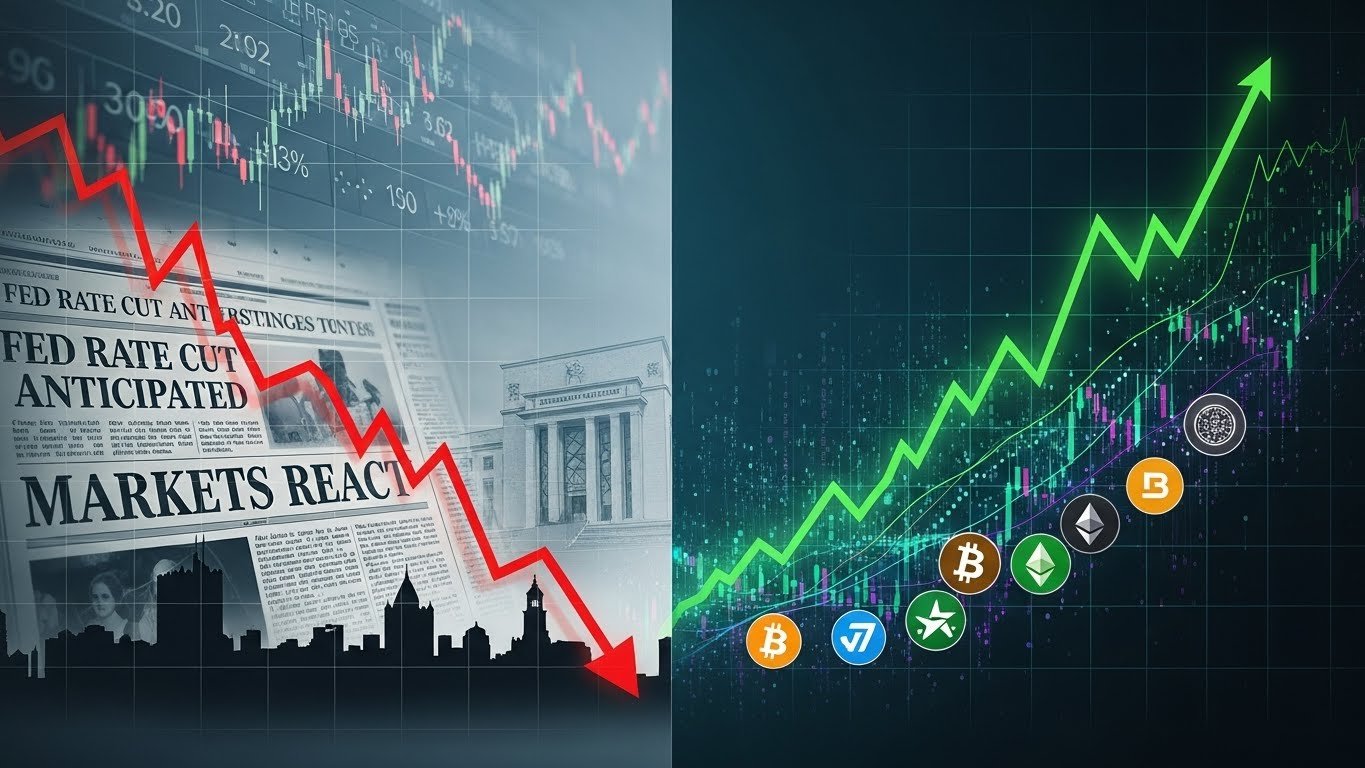
This is one reason Bitcoin and ether have become increasingly correlated with broader macro conditions. In a high-rate environment, holding cash and short-term yield instruments becomes more attractive. But if the market believes those yields will decline in the future, capital tends to rotate toward assets that may outperform under easier financial conditions.
Crypto responds strongly because Bitcoin and ether are inherently liquidity-sensitive assets. When liquidity expands, speculative markets often rise. When liquidity tightens or uncertainty grows, speculative markets tend to cool. That’s why Bitcoin and ether can rally hard on a “Fed pivot” narrative—and then ease just as quickly when traders question whether the pivot will arrive sooner or later than expected.
The key is that crypto rarely reacts to interest rates alone. It reacts to the entire ecosystem of rates, inflation, growth, and sentiment. A Fed cut driven by a soft landing and cooling inflation can be bullish for Bitcoin and ether. A Fed cut driven by economic stress can be volatile, because investors may initially flee risk assets before returning once the environment stabilizes.
The role of real yields, the dollar, and risk appetite
Beyond the headline rate, traders also watch real yields, the U.S. dollar, and overall risk appetite. These are some of the most influential macro forces shaping Bitcoin and ether.
Real yields represent the return investors earn after inflation. When real yields are high, holding cash and bonds becomes more attractive, and speculative assets can struggle. When real yields fall, it often supports risk assets, including crypto. That’s because the opportunity cost of holding non-yielding assets—like Bitcoin—becomes less painful when the “safe” return shrinks.
The U.S. dollar also plays a major role. Bitcoin and ether are priced globally, but the dominant trading denomination is the dollar. When the dollar strengthens, it can put pressure on dollar-denominated assets, making them more expensive for international buyers. When the dollar weakens, it can support Bitcoin and ether by improving global purchasing power.
Risk appetite in equities is another major piece of the puzzle. Crypto increasingly behaves like high-beta tech: when stocks rally and volatility falls, Bitcoin and ether often rise. When stocks wobble and volatility spikes, crypto often eases. That’s why it’s common to see Bitcoin and ether cooling when broader markets become cautious, especially around major data releases.
Bitcoin, ether, and the ETF flow factor
One of the biggest structural shifts in recent crypto history is the rise of spot Bitcoin ETFs. These products have transformed how institutions and retail investors gain exposure to Bitcoin. Rather than needing crypto exchanges or specialized custody solutions, investors can buy Bitcoin exposure through familiar financial platforms.
This development has introduced a powerful new price driver: ETF flows.
When spot Bitcoin ETFs see strong inflows, they create steady demand for Bitcoin. This can support price even during uncertain macro periods. When ETFs see outflows, however, they can add selling pressure, especially if those outflows happen during broader risk-off conditions.
ETF flows have also made Bitcoin more sensitive to traditional market cycles. In the past, crypto was often driven by crypto-native catalysts. Now, Bitcoin increasingly responds to the same flow mechanics that drive equity and bond markets—portfolio rebalancing, risk reduction, and institutional positioning.
For Bitcoin, ETF demand can act like a long-term tailwind. But in the short term, ETF outflows can contribute to easing moves after rallies, reinforcing the “cooling” effect that occurs after an early January pop.
Why ether often drops more than Bitcoin during pullbacks
Ether often behaves differently from Bitcoin during pullbacks, and understanding that difference can help investors interpret the market better.
Bitcoin is widely considered the crypto market’s primary asset. It is the most liquid, the most widely held, and often the first choice for institutional exposure. When markets reduce risk, Bitcoin tends to hold up better than many other crypto assets because it’s seen as the “core” position.
Ether, by contrast, is often treated more like a growth asset. It’s linked to the broader Ethereum ecosystem: decentralized finance activity, token issuance, on-chain usage, and scaling solutions. Ether can rise faster than Bitcoin during strong bullish cycles, but it can also fall faster when risk appetite declines.
This is one reason why, when Bitcoin and ether ease after an early January pop, ether often shows more volatility. Traders tend to de-risk the most volatile assets first. Ether’s deeper ties to broader crypto innovation also mean it sometimes reacts more strongly to shifts in sentiment.
However, this volatility is not necessarily bearish in the long run. Many bull cycles feature periods where ether underperforms briefly, then rebounds aggressively when market confidence returns.
The early January pop: what likely fueled it
The early January pop in Bitcoin and ether was powered by a mix of technical momentum, seasonal repositioning, and macro optimism.
The start of the year often brings fresh capital allocations, new institutional positioning, and renewed market energy. Traders and investors who stayed cautious in late December frequently return in early January with a clearer outlook and a willingness to take risk. That can boost liquidity and amplify price moves.
Bitcoin also benefits from psychological levels. When Bitcoin pushes toward major price milestones, it attracts attention, headlines, and momentum traders. This creates a loop where rising price generates more demand, at least temporarily.
Additionally, the belief that markets are pricing Fed cuts creates a supportive narrative. Investors anticipate that easing monetary policy could improve financial conditions later in the year, making it easier to justify exposure to assets like Bitcoin and ether. Even if rate cuts are months away, markets often move in advance.
The early January pop was likely the result of these forces combining at once: seasonal momentum, narrative alignment, and technical strength.
What the pullback means for traders and long-term investors
A pullback after a rally can mean different things depending on your time horizon.
For short-term traders, Bitcoin and ether easing after the early January pop is a signal to reassess momentum. Traders often look for confirmation that support levels will hold, volume will return, and catalysts will reappear. In short-term trading, the goal is not to predict the entire year but to manage risk, avoid over-leverage, and adapt to volatility.
For long-term investors, the easing move may be seen as a normal consolidation. Strong bull markets often include pullbacks that reset sentiment and reduce excess leverage. These pullbacks can create healthier market conditions, making future rallies more sustainable.
The most important takeaway is that Bitcoin and ether easing does not automatically invalidate the Fed cuts narrative. It simply reflects that markets are constantly repricing the timing and probability of policy changes. Crypto is forward-looking, and forward-looking markets tend to move in waves.
The Fed cuts narrative: what traders are watching next
If Bitcoin and ether are easing because markets are pricing Fed cuts with uncertainty, the next phase depends on what happens with macro data and central bank messaging.
The market is typically most sensitive to inflation readings, employment data, and any signals that growth is slowing or accelerating. If inflation appears sticky, traders may push rate cuts further out, which could pressure risk assets. If inflation cools convincingly, the market may increase confidence that cuts are coming, supporting Bitcoin and ether.
Central bank communication is equally important. Even if data supports easing, policymakers may remain cautious to avoid reigniting inflation. If the Fed emphasizes patience, markets can cool. If the Fed becomes more confident that inflation is under control, markets may rally again.
This is why Bitcoin and ether often move in tandem with bond yields. A drop in yields can support crypto, while a spike in yields can pressure it. The market is constantly recalibrating.
Bitcoin and ether in 2026: a bigger structural shift
Beyond the short-term easing move, the bigger story is that Bitcoin and ether are now more integrated into global finance than ever before.
Institutional participation has grown. ETF structures have expanded access. Macro traders are increasingly active in crypto markets. These changes don’t reduce volatility—they often increase it—but they also deepen liquidity and make crypto a more permanent part of the investment landscape.

This integration also means Bitcoin and ether are more influenced by the same forces that drive other global assets: rates, liquidity, risk appetite, and positioning. In many ways, Bitcoin has become a macro asset, while ether remains a hybrid of macro sensitivity and technology-driven adoption.
For investors, this means the ability to interpret macro conditions is becoming just as important as understanding blockchain fundamentals.
What could restart upside momentum after the easing move
If Bitcoin and ether have eased after their early January pop, what could bring momentum back?
One catalyst is a clear shift in macro expectations. If data supports earlier or deeper Fed cuts than previously assumed, risk appetite could rise, pushing Bitcoin and ether higher.
Another catalyst is a return of strong institutional demand. If ETF flows strengthen again, Bitcoin could regain upward momentum, potentially pulling ether and the broader market with it.
A third catalyst is improved sentiment across equities. Crypto continues to trade in sympathy with broader risk appetite. If global markets stabilize, volatility falls, and investors rotate back into growth, crypto can benefit.
The market is not only waiting for a single headline. It’s waiting for alignment—macro support, strong flows, and renewed technical momentum.
Conclusion
Bitcoin and ether easing after an early January pop is a classic example of how crypto markets respond to changing expectations. The early surge reflected optimism around Fed cuts, liquidity, and renewed risk appetite. The pullback reflects profit-taking, caution ahead of macro data, and constant repricing of the rate-cut timeline.
As markets price Fed cuts, Bitcoin and ether remain highly sensitive to bond yields, the U.S. dollar, and institutional flows, including spot Bitcoin ETFs. The long-term trend may still be constructive, but the short-term path will likely be shaped by macro signals and shifting sentiment.
For investors, the key is to stay focused on what actually drives price: liquidity expectations, positioning, and adoption. Bitcoin and ether may ease today, but the forces shaping 2026 are still evolving—and the next major move will depend on where the Fed narrative lands next.
FAQs
Q: Why did Bitcoin and ether ease after the early January pop?
Bitcoin and ether eased mainly due to profit-taking after a fast rally and increased caution as traders reassessed macro expectations around Fed cuts and upcoming economic data.
Q: How do Fed cut expectations affect Bitcoin and ether?
When markets price Fed cuts, traders often expect easier financial conditions and improved liquidity, which can support risk assets like Bitcoin and ether. If expectations shift, crypto can pull back quickly.
Q: Why does ether often fall more than Bitcoin during pullbacks?
Ether is typically more volatile and more sensitive to broader risk sentiment than Bitcoin. During cautious periods, traders often reduce exposure to higher-beta assets first.
Q: What role do spot Bitcoin ETFs play in Bitcoin’s price?
Spot Bitcoin ETFs introduce flow-driven demand and selling pressure. Strong inflows can support Bitcoin, while outflows can amplify short-term pullbacks.
Q: Is this easing move bearish for the rest of 2026?
Not necessarily. Crypto markets often pull back after sharp rallies. Whether Bitcoin and ether continue higher depends on macro data, Fed messaging, ETF flows, and broader risk sentiment.
See More: Bitcoin Price Today at $92.7K Why BTC Is Falling and What It Means