Accumulation Phase Returns Top Altcoins & Presale Pick
Accumulation phase returns as 10 altcoins strengthen and one standout emerges as the best crypto presale to buy now. Key trends, risks, FAQs.


Crypto markets move in cycles, but the moments that quietly shape the next breakout often look boring in real time. That’s why “accumulation phase returns” has become a phrase traders and long-term holders watch closely. When an accumulation phase returns, it signals a period where price volatility cools down, sellers get exhausted, and patient capital begins positioning before the broader crowd notices. This is typically when high-conviction investors shift from watching charts to building exposure, especially in projects with clear utility, improving network metrics, and active communities.
In many market cycles, the accumulation phase returns after a sharp correction or a long sideways stretch. The headlines may still feel uncertain, but under the surface, capital rotates into fundamentally resilient assets—often led by major altcoins and then followed by smaller caps. That rotation can create a meaningful window for investors seeking favorable entry points, because accumulation phases tend to offer better risk-to-reward than late-stage momentum rallies. The result is a market environment where top altcoins strengthen simultaneously, and where early-stage opportunities—like a carefully vetted presale—can capture attention as the “best crypto presale to buy now” for those willing to do deeper research.
This article explores what it really means when the accumulation phase returns, why the top 10 altcoins strengthen during these periods, and what typically makes one project stand out as the best crypto presale to buy now. You’ll also learn how to approach presales with a realistic view of risk, how to interpret on-chain and market structure signals, and how to keep your decision-making grounded when narratives heat up.
Accumulation Phase Returns in Crypto
When the accumulation phase returns, it generally refers to a market structure in which price consolidates in a range while stronger hands steadily accumulate. In classic cycle behavior, this tends to happen after a distribution phase (where early buyers take profit) and a markdown phase (where prices fall and fear dominates). During accumulation, price may appear “stuck,” but the underlying order flow often tells a different story: sell pressure weakens, bid support becomes more consistent, and long-term holders begin increasing positions.
What Accumulation Looks Like in Real Market Behavior
In practical terms, accumulation phase returns can show up as multiple weeks or months of sideways movement, relatively muted volatility, and repeated rejection of lower lows. You’ll often see volume patterns shift as well—spikes on dips (buyers stepping in) and lower activity on rallies (less aggressive chasing). The emotional tone of the market also changes. Instead of euphoric “up only” sentiment, you get skepticism, fatigue, and cautious optimism. That emotional backdrop is crucial because accumulation thrives when most participants are disengaged or uncertain.
Why Altcoins Strengthen During Accumulation
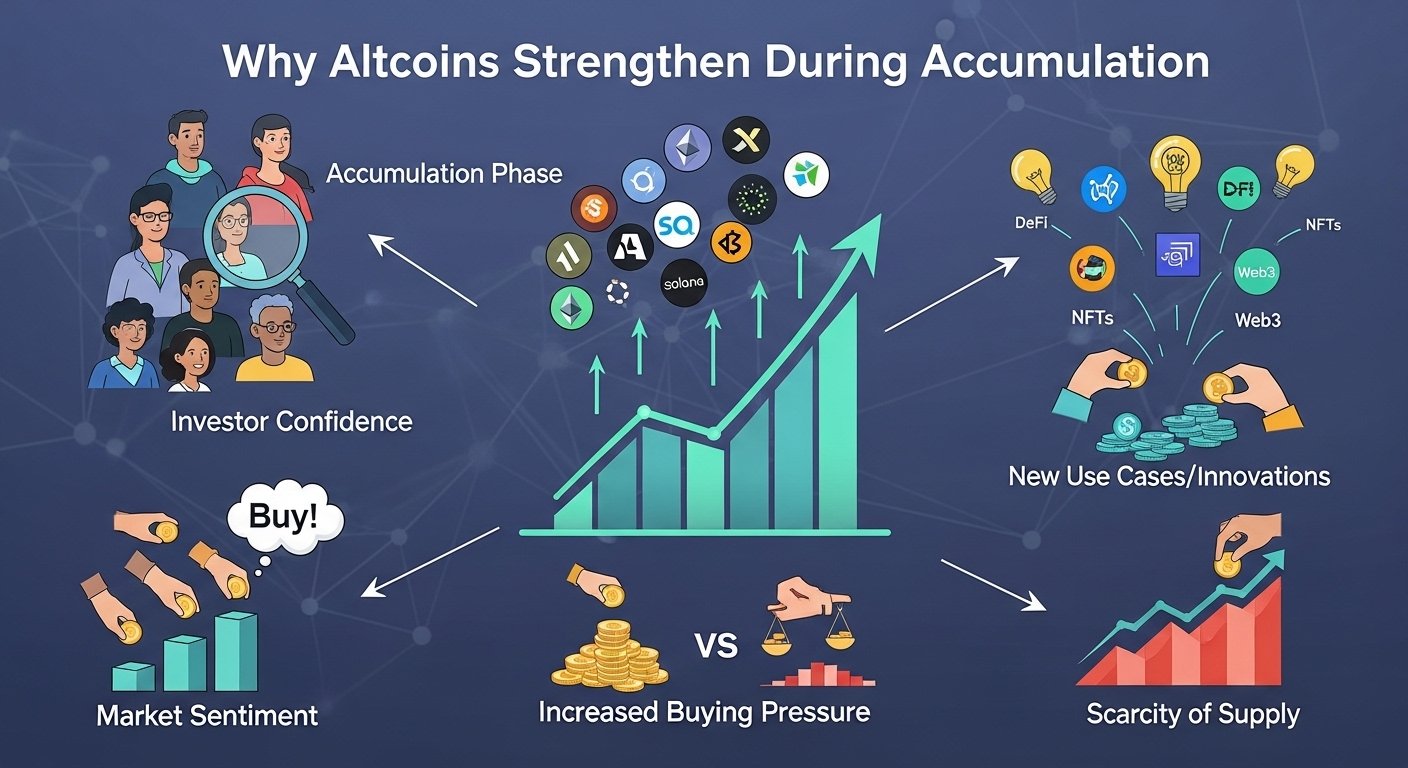
It might sound counterintuitive that top altcoins strengthen during periods that look dull, but it’s actually common. When the accumulation phase returns, investors start hunting for assets that could outperform in the next expansion. Top altcoins strengthen because they tend to have deeper liquidity, clearer narratives, and more established ecosystems than smaller projects. That combination attracts rotating capital: traders want volatility and upside, while investors want credible long-term themes like smart contracts, scaling, interoperability, real-world assets, AI infrastructure, or DeFi rails.
Accumulation Phase Returns and the Shift Toward Quality
One of the clearest signals that an accumulation phase returns is the market’s renewed preference for quality. In late bull-market conditions, almost anything can pump. In accumulation, however, the market becomes selective. Liquidity concentrates in projects with strong development activity, high usage, recognizable leadership, and credible roadmaps.
The Role of Liquidity and Market Confidence
Liquidity is the invisible engine behind many rallies. During accumulation, liquidity tends to return gradually, often starting with large-cap and mid-cap assets. That’s part of why the top 10 altcoins strengthen: they’re easier to enter and exit without dramatic slippage, which matters to both institutions and larger retail investors. As confidence rebuilds, these assets can move first, drawing attention and setting the tone for broader risk-on behavior later.
Why Narratives Re-Form in Accumulation
When the accumulation phase returns, it also brings narrative rebuilding. Investors start asking: Which sectors have real adoption? Which protocols are shipping? Which tokens have sustainable tokenomics? This is when LSI keywords and related themes—like on-chain metrics, market cycle, risk management, and crypto portfolio strategy—become practical tools rather than buzzwords. The market begins to reward clarity: projects with transparent updates and tangible progress gain strength while hype-only coins often fade.
Top 10 Altcoins Strengthen: The Forces Driving Their Momentum
Even without listing coins, the “top 10 altcoins strengthen” idea is less about a fixed ranking and more about a pattern: leading altcoins gain relative strength when capital seeks established exposure. When the accumulation phase returns, you’ll often see a cluster of high-quality altcoins tightening up, reclaiming key levels, and showing better resilience than the broader market.
Smart Contract Platforms and Ecosystem Gravity
Smart contract networks are frequently among the first areas where top altcoins strengthen. This is because they operate like economic hubs: developers build, users transact, and value accrues through fees, staking, and ecosystem growth. When accumulation phase returns, these ecosystems can show improving metrics such as higher active addresses, rising TVL in DeFi, or increased NFT and gaming activity. Even modest improvements can matter because markets trade on expectations as much as current reality.
In these environments, layer-1 and layer-2 scaling narratives can reawaken. Investors often look for chains that reduce friction—faster finality, cheaper transactions, better developer tooling—because those traits become competitive advantages when usage ramps again.
Interoperability and Modular Infrastructure
Another reason top altcoins strengthen during accumulation is the market’s interest in infrastructure that connects ecosystems. Interoperability protocols, modular stacks, and cross-chain messaging solutions can regain attention because they’re essential for scaling the broader crypto economy. When liquidity returns, it rarely concentrates in one chain forever. Capital moves, users bridge, and applications expand across networks. In that context, projects supporting multi-chain growth can benefit as the accumulation phase returns and investors anticipate the next wave of adoption.
DeFi Blue Chips and Yield-Driven Demand
Decentralized finance often rebounds early as well. When the accumulation phase returns, traders and investors start looking for productive assets, not just speculative pumps. DeFi protocols offering lending, trading, derivatives, liquid staking, and yield strategies can attract renewed usage. That usage can support token demand, especially when token utility is tied to fees, governance, or protocol incentives. During accumulation, yield can be a powerful magnet because it gives investors a reason to hold while waiting for price appreciation. This is where Bold LSI phrases like staking rewards, real yield, liquid staking, and DeFi adoption naturally fit into the conversation. They reflect what investors care about when markets stop being purely momentum-driven.
AI and Data Infrastructure Tokens
In newer cycles, AI-related crypto infrastructure has become a common narrative. When accumulation phase returns, investors may revisit AI tokens that offer compute marketplaces, data availability layers, agent tooling, or decentralized inference networks. The key difference in accumulation is that the market tends to prefer projects that demonstrate real usage rather than just riding a trend. Tokens tied to measurable demand—like fees paid for compute or network participation—often perform better when the top 10 altcoins strengthen and the market becomes more fundamentals-aware.
How to Evaluate Strength When the Accumulation Phase Returns
It’s easy to get fooled by short-term pumps. In an accumulation environment, the more useful question is whether a project is strengthening structurally. That means looking beyond price and toward indicators that suggest persistent demand.
Price Structure and Relative Strength
When the accumulation phase returns, leaders typically stop making new lows before the market does. That “relative strength” can appear as faster recoveries after dips or longer periods of stable support. If top altcoins strengthen while smaller caps remain weak, that can indicate a “quality-first” rotation—often a healthy sign for the broader cycle.
Network Fundamentals and On-Chain Signals
On-chain signals can help confirm whether accumulation is real. While no metric is perfect, increasing active addresses, stable or rising transaction counts, improving fee revenue, and consistent development activity can suggest that demand is organic rather than purely speculative. During periods when the accumulation phase returns, these fundamentals often improve quietly before price catches up.
Tokenomics and Supply Dynamics
Supply matters. Projects with heavy unlock schedules, inflationary emissions, or weak utility can struggle even if the narrative is strong. If top altcoins strengthen, they often do so because their token models are better understood and perceived as more sustainable. When you’re navigating an accumulation environment, understanding supply dynamics is part of intelligent risk control—especially if you’re also exploring a presale pitched as the best crypto presale to buy now.
One Emerges as the Best Crypto Presale to Buy Now: What “Best” Should Actually Mean

The phrase “best crypto presale to buy now” gets thrown around constantly, but in a serious investment context, “best” shouldn’t mean “loudest marketing.” If the accumulation phase returns and investors are positioning early, a presale can be attractive—but only if it’s backed by strong fundamentals, transparent execution, and realistic tokenomics.
What Separates a Strong Presale From a Risky One
A credible presale tends to show several traits. It has a clearly defined product or protocol, a roadmap that can be verified through tangible milestones, and a team that communicates transparently. It also avoids overly aggressive promises. In crypto, high upside is possible, but guarantees are not. When a project claims it is the best crypto presale to buy now, the burden of proof should be on evidence: working prototypes, audits, partnerships that can be confirmed, and a token model that doesn’t rely on endless inflation.
In addition, a strong presale should explain how the token captures value. If the token is only a fundraising instrument with no real utility, it may struggle once it lists. The best crypto presale to buy now—if it truly deserves that label—should align token demand with real usage, such as fee payments, staking requirements, governance rights with meaningful scope, or access to network resources.
Why Presales Become Popular When the Accumulation Phase Returns
When accumulation phase returns, many investors feel like they missed earlier cycles and want early exposure. Presales create that opportunity. They also tap into a psychological advantage: you’re buying before exchange listings, before price discovery, and before mainstream attention. But that advantage comes with serious risk. Presales can be illiquid, subject to delays, and vulnerable to execution failures. That’s why the best approach is to treat presales as a high-risk allocation rather than a core portfolio replacement.
Red Flags to Avoid While Hunting the Best Crypto Presale to Buy Now
A presale becomes dangerous when it has unclear token distribution, no lockups for insiders, unverifiable claims, or a roadmap that’s heavy on hype and light on engineering. Overly complex jargon without clear explanations is another warning sign. If the accumulation phase returns and the market is becoming more selective, these weaker presales can struggle to sustain attention beyond their initial marketing push.
Building a Strategy as Top Altcoins Strengthen
When the top 10 altcoins strengthen and the accumulation phase returns, many investors face the same challenge: how to allocate capital without getting overexposed. The best strategies usually balance conviction with humility. Even strong projects can experience deep drawdowns in crypto, and narratives can shift quickly.
Blending Core Altcoin Exposure With Selective Presale Bets
A common approach is to treat major altcoins as the core of a higher-risk crypto sleeve, then layer in smaller positions for asymmetrical upside—such as a presale candidate that appears to meet the standards of the best crypto presale to buy now. This blend can help manage volatility because large caps typically have better liquidity and more stable demand than early-stage tokens.
Timing, Patience, and Risk Management
Accumulation rewards patience. If the accumulation phase returns, it often means the market is offering time—time to research, build positions gradually, and avoid emotional overtrading. A steady approach also reduces the temptation to chase pumps. When top altcoins strengthen, the goal isn’t to catch every move; it’s to participate in the broader trend while keeping risk controlled.
The Value of Realistic Expectations
Even when conditions look promising, no cycle moves in a straight line. There can be fakeouts, sharp pullbacks, and sudden sentiment shifts. If you’re considering the best crypto presale to buy now, the same realism matters even more. Presales are not guaranteed winners, and diversification within your risk budget can be the difference between a manageable setback and a portfolio-level mistake.
Conclusion: The Opportunity When the Accumulation Phase Returns
When the accumulation phase returns, markets often feel quiet—but the groundwork for the next major expansion can be forming. This is why traders and investors pay attention when the top 10 altcoins strengthen: it can signal a quality-first rotation and a return of confidence. At the same time, the search for one standout opportunity—the best crypto presale to buy now—tends to intensify, because early-stage projects can offer outsized upside if they’re credible, transparent, and built for real demand.
The best way to navigate this environment is to stay disciplined. Focus on structural strength, not just hype. Look for sustainable tokenomics, real utility, and consistent execution. If you combine thoughtful exposure to strong altcoins with selective, research-driven presale participation, you’ll be positioned to benefit if the accumulation phase returns evolves into the next broader rally.
FAQs
Q: What does it mean when the accumulation phase returns in crypto?
When the accumulation phase returns, it typically means price consolidates after a decline while long-term investors gradually buy, reducing sell pressure and setting up a potential future uptrend.
Q: Why do top altcoins strengthen during accumulation periods?
Top altcoins strengthen because liquidity often returns to established projects first, and investors prefer assets with stronger fundamentals, clearer narratives, and deeper markets during uncertain phases.
Q: Is the best crypto presale to buy now always a good investment?
Not necessarily. The “best crypto presale to buy now” is a marketing phrase unless supported by evidence like utility, transparent tokenomics, credible team execution, and verifiable progress.
Q: What should I look for before joining a crypto presale?
Look for clear token utility, transparent allocations and lockups, realistic roadmap milestones, security practices like audits, and communication that avoids unrealistic promises.
Q: How can I reduce risk when investing as the accumulation phase returns?
You can reduce risk by focusing on higher-quality assets, sizing presale positions conservatively, researching tokenomics and fundamentals, and staying patient rather than chasing short-term price spikes.
See More: Bitcoin Stuck in a Triangle — Calm Before a 15% Storm?