
Iran Crypto Outflows Surge 700%, Market Shaken
Iran crypto outflows jumped 700%, shaking confidence and liquidity. Explore the triggers, risks, and what Iranian traders can do next.

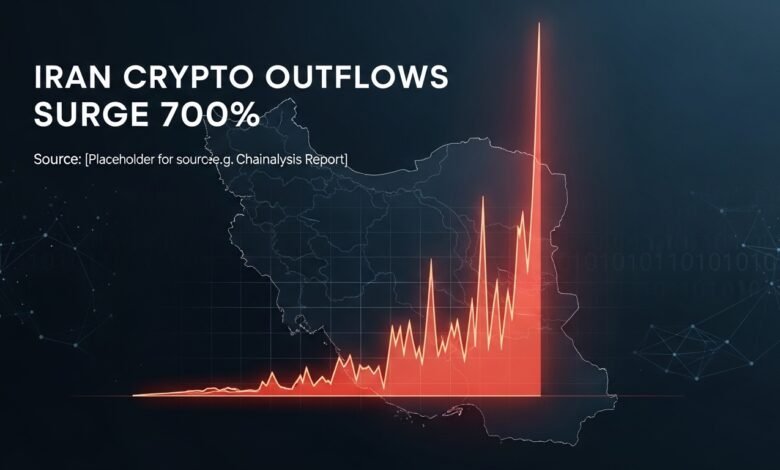
Iran’s crypto market has always lived at the intersection of necessity and uncertainty. For many users, digital assets aren’t just a speculative bet; they’re a practical workaround in an economy shaped by currency pressure, limited financial access, and recurring moments of political tension. That’s why the recent shock—when Iran crypto outflows reportedly surged about 700% in a short window—landed like an alarm bell across the region’s digital asset ecosystem. A jump that steep doesn’t happen in quiet markets. It happens when people feel time is shrinking, risk is expanding, and access could disappear at any moment.
At its core, the story is about behavior under stress. When fear rises, people don’t simply trade; they move. They withdraw from platforms, shift funds into self-custody, rotate into stablecoins, and search for liquidity that feels safer, faster, and harder to freeze. In places with fragile connectivity, an added layer of urgency appears: if internet disruptions are possible, the “window” to act can feel painfully small. That mix—geopolitical anxiety, liquidity concerns, and connectivity risk—can turn an ordinary withdrawal day into a rush that shakes the entire market.
This article breaks down what the 700% surge in Iran crypto outflows likely means, why it matters for Iranian users and the wider crypto industry, and what patterns to watch next. We’ll explore the mechanics behind exchange outflows, the reasons panic withdrawals happen so quickly, and the real-world consequences for liquidity, pricing, and market trust. Along the way, you’ll see important LSI keywords and related phrases highlighted in bold to support search visibility while keeping the writing natural and readable. By the end, you’ll have a clearer picture of why Iran’s crypto ecosystem reacted so sharply, and what this moment reveals about digital finance in high-risk environments.
What “Iran Crypto Outflows” Actually Measures
When headlines say Iran crypto outflows skyrocketed 700%, the key is understanding what “outflows” are and how analysts interpret them. In crypto markets, an outflow typically refers to assets leaving an exchange’s wallets to external addresses. That movement can be driven by many reasons, but during a shock event it often signals one dominant behavior: users are moving funds away from centralized custody.
Outflows are different from trading volume. Trading volume measures how much is being bought and sold on a platform. Outflows measure how much is being withdrawn or transferred away. A market can have high trading volume but low outflows if users keep funds on the exchange. It can also have relatively modest trading volume but huge outflows if users aren’t trying to trade—they’re trying to escape risk. When Iran crypto outflows spike dramatically, it suggests the second scenario is at play: a surge in withdrawals, not necessarily a surge in speculation.
Another point is the meaning of a 700% jump. A percentage spike is usually calculated against a baseline from a recent period. That baseline might be the typical hourly outflow level or an average over a day. A 700% surge implies withdrawals were roughly eight times the baseline. Even if the absolute dollar amount varies by source and method, the behavioral message is consistent: this was a sudden, intense shift from holding on-platform to moving off-platform.
Why Outflows Spike Fast During Crisis Moments
In high-stress situations, markets operate on reflex. Users don’t wait for certainty. They anticipate what might happen next, and in financial terms that often means preparing for the worst-case scenario. If people believe exchanges could face disruptions, regulatory pressure, or forced pauses, the rational move is to withdraw early rather than late. In that context, Iran crypto outflows become a kind of heartbeat monitor for market anxiety.
In Iran’s environment, this reflex is amplified. Many users have experienced volatility in currency conditions and periods of heightened restrictions. That history trains a certain kind of market muscle memory: when the risk signal spikes, act quickly. The result can be a cascade, where early withdrawals prompt others to follow, creating an outflow wave that becomes self-reinforcing.
The Immediate Trigger: Fear, Uncertainty, and the Rush to Self-Custody
A surge in Iran crypto outflows of this magnitude is rarely random. It tends to be linked to a powerful trigger that shifts perceived risk in minutes, not days. During major geopolitical events, people often worry about rapid changes to financial access. Even the possibility of sudden tightening is enough to prompt action.
For Iranian users, the threat landscape during escalations can feel multi-layered. There’s the fear of instability spilling into economic policy. There’s the fear that exchanges could be pressured or disrupted. There’s the fear of connectivity problems that might prevent access. And there’s the fear of currency turbulence that can erode purchasing power quickly. In that kind of environment, crypto becomes both a lifeboat and a crowded doorway.
This is where the psychology behind Iran crypto outflows matters. Many withdrawals are not “market timing.” They’re safety moves. Users withdraw to personal wallets to reduce counterparty risk, to increase control over funds, and to prepare for an uncertain period where access might become unpredictable.
How Internet Disruptions Can Shape Outflows
Crypto depends on connectivity. Exchanges rely on users being able to log in, complete security checks, and submit withdrawal requests. Blockchains require nodes, confirmations, and network access to broadcast transactions. If users fear outages, they may rush withdrawals before a potential shutdown. That can spike Iran crypto outflows quickly, then abruptly reduce activity not because fear is gone, but because access is interrupted.
This “surge-then-freeze” pattern is common in markets where connectivity is fragile. The most intense activity happens in the short window where users still have access. If an outage follows, the outflows may slow even though the demand to withdraw remains. That’s why analysts often interpret the first burst of outflows as the clearest behavioral signal.
Why Iran’s Crypto Market Reacts So Sharply to Risk
Iran’s crypto market has unique structural pressures that make it more sensitive to shocks than many other markets. The first pressure is macroeconomic. In environments where people worry about inflation and currency stability, crypto assets—especially stablecoins—can become an alternative store of value. The second pressure is access.
When international banking rails are complicated, people may rely on crypto for cross-border value movement, online payments, and hedging. The third pressure is policy uncertainty. When rules can change quickly during political tensions, users are more likely to keep assets portable. These pressures create a market where Iran crypto outflows are not merely a technical metric. They’re a social signal. They reflect how fast confidence can change and how quickly the public seeks control over savings.
The Role of Capital Flight Dynamics
In traditional finance, capital flight happens when people move money out of a country or financial system to protect wealth. Crypto can accelerate that behavior because it can move across borders without traditional bank transfers—at least in theory. When users fear tightening controls or deteriorating stability, can represent a form of digital capital flight.
However, it’s important to avoid oversimplification. Not every outflow is a cross-border move. Some withdrawals are simply shifting to personal wallets for safer custody. Others might be moving to different platforms, different chains, or different asset types. Still, the scale and speed implied by a 700% surge strongly suggests a defensive move rather than routine rebalancing.
Domestic Exchanges Under Pressure: Liquidity, Trust, and Operational Stress
When Iran crypto outflows spike, domestic exchanges become the center of attention. Centralized exchanges are where many retail users keep funds because it’s easier to trade, convert, and manage balances. But during a crisis, what was convenient becomes risky. The biggest question becomes brutally simple: “Can I withdraw if I need to?” This is where exchange resilience matters. If an exchange can handle heavy withdrawal requests smoothly, it can stabilize confidence. If it struggles—due to operational limitations, blockchain congestion, banking constraints, or security freezes—fear can intensify and accelerate more withdrawals.
What Outflows Do to Market Depth

Liquidity is not just a buzzword; it’s the difference between a stable market and a chaotic one. When users withdraw, the exchange loses available balances that support trading. If enough funds leave, the market can become thinner. Thin markets create wider spreads, more slippage, and sharper price movements. That in turn makes users more nervous, potentially increasing Iran crypto outflows further. In practical terms, this can lead to a cycle. Users withdraw, liquidity falls, pricing worsens, and then more users withdraw because they don’t like what they see. Breaking that cycle requires confidence, uptime, and clear communication.
The Stablecoin Effect: Why Users Often Flee Into Digital Dollars
During periods of uncertainty, users often shift away from volatile assets and into stablecoins. The logic is simple: price stability is valuable when everything else feels unstable. Even if stablecoins carry their own risks, they reduce the day-to-day volatility that can magnify anxiety. In many emerging markets, stablecoins act like a digital version of holding dollars. For users worried about local currency weakness, stablecoins can be a hedge.
For users worried about access, stablecoins can be a portable form of value that can be stored in self-custody. This is why Iran crypto outflows can be linked with increased stablecoin demand. When people withdraw, they often withdraw in a form they expect to hold, not trade. Stablecoins fit that purpose. The market consequence can be rising stablecoin premiums, increased demand for liquidity, and stronger pressure on local exchange reserves.
Custody Risks: Self-Custody Is Control, But Not Always Safety
Self-custody is often presented as the solution during crises: “Not your keys, not your coins.” While the principle is valid, self-custody also introduces risks that many users underestimate. In times of stress, people rush. Rushing increases mistakes. Mistakes in crypto can be irreversible. Sending funds to the wrong address, falling for phishing links, losing seed phrases, or storing keys insecurely can turn a protective move into a permanent loss.
That’s why spikes in Iran crypto outflows can create a second-wave risk: increased vulnerability to fraud and error. A mature response to crisis involves balance—reducing counterparty risk without increasing personal operational risk. That’s easier said than done, especially when the pressure is emotional and time-sensitive.
On-Chain Analytics and Interpretation: Why the Story Spread So Fast
One reason the Iran crypto outflows surge became a major headline quickly is the rise of on-chain data analysis. Blockchain activity is transparent. Skilled analysts can identify exchange-associated addresses, track net flows, and detect anomalies in near real time. However, there are limitations. Analysts can see movement, but intent is inferred. A large outflow could reflect users withdrawing, the exchange reshuffling wallets, or a combination of both.
But timing is a powerful clue. When outflows spike minutes after a shock event, the simplest explanation is often the correct one: users reacted to fear. The fact that the outflow surge was described as immediate also supports the behavioral story. Operational reshuffles tend to be scheduled and less sensitive to global news. Panic behavior, on the other hand, is extremely sensitive to headlines and rapidly changing conditions.
Why “700%” Became the Number Everyone Repeated
People repeat numbers that sound dramatic, and 700% is dramatic. But it also lands because it captures urgency more than an absolute figure might. A high percentage change signals a break from normal behavior. It tells readers this wasn’t business as usual. In SEO terms, “700% surge” is a compelling phrase because it communicates both magnitude and momentum. From a market perspective, the value is not the drama—it’s the signal. When Iran crypto outflows jump that hard, it implies trust shifted quickly. Trust is one of the most important “invisible assets” in crypto, especially in markets where traditional alternatives are limited.
Broader Market Implications: Regional Ripple Effects and Global Sentiment
While Iran’s crypto market is the epicenter, major shocks can ripple outward. When a localized crisis causes demand for stablecoins and offshore liquidity, regional markets may feel it. Traders in nearby regions may see pricing distortions, increased demand for certain assets, or higher premiums for on-ramp access. At the same time, geopolitical escalations can influence global crypto sentiment. Risk-off behavior can spread when investors fear broader instability. That doesn’t mean global markets move in lockstep with Iranian flows, but it does mean events that trigger Iran crypto outflows can also feed into a wider narrative of uncertainty.
Compliance Pressure and the Risk of Increased Restrictions
Whenever headlines focus on Iran and crypto in the same breath, compliance pressure rises. Exchanges outside Iran may heighten monitoring for sanctioned exposure. Platforms may restrict certain flows more aggressively. Payment rails may become more cautious. Even if most users are simply protecting savings, increased scrutiny can create more friction across the ecosystem. This matters because friction shapes behavior. If users believe future access will become harder, they may withdraw more now. That expectation can increase Iran crypto outflows further, creating a feedback loop driven not just by immediate fear, but by anticipation of future restrictions.
What Happens Next: Signals to Watch After the Outflow Shock
The most important question after a dramatic spike in Iran crypto outflows is whether behavior normalizes or becomes a new baseline. If conditions stabilize, outflows may decline as users regain confidence and return balances to exchanges for convenience. If conditions remain tense, users may keep funds in self-custody and use exchanges only for short-term conversions. That would reduce domestic liquidity over time and could make future shocks even more volatile. There are several signals that can indicate which path is forming.
The first is whether net outflows remain elevated beyond the initial shock period. A one-time spike suggests panic that passes. Persistent outflows suggest structural distrust. The second signal is whether trading volumes recover. If volumes remain low while outflows continue, it may indicate users are leaving without returning. The third signal is stablecoin pricing and availability. If stablecoin demand remains unusually high, it implies ongoing hedging and defensive positioning. Finally, watch for operational and policy shifts. Changes in exchange withdrawal policies, connectivity reliability, or domestic rules can influence user behavior quickly. In a market already sensitized to risk, even small disruptions can trigger new waves of Iran crypto outflows.
Conclusion
The reported 700% jump in Iran crypto outflows is more than a dramatic statistic. It’s a snapshot of how crypto behaves when fear and uncertainty accelerate faster than policy and infrastructure can respond. When they withdraw at scale, liquidity thins and trust becomes fragile. And when trust becomes fragile, future shocks can hit harder. Whether this outflow surge becomes a one-time panic response or a longer-term shift will depend on what happens next: stability versus escalation, uptime versus disruption, and confidence versus continued caution. For now, the lesson is clear. Iran crypto outflows are not just numbers on a dashboard—they’re a real-time reflection of how quickly people move when the future feels uncertain.